
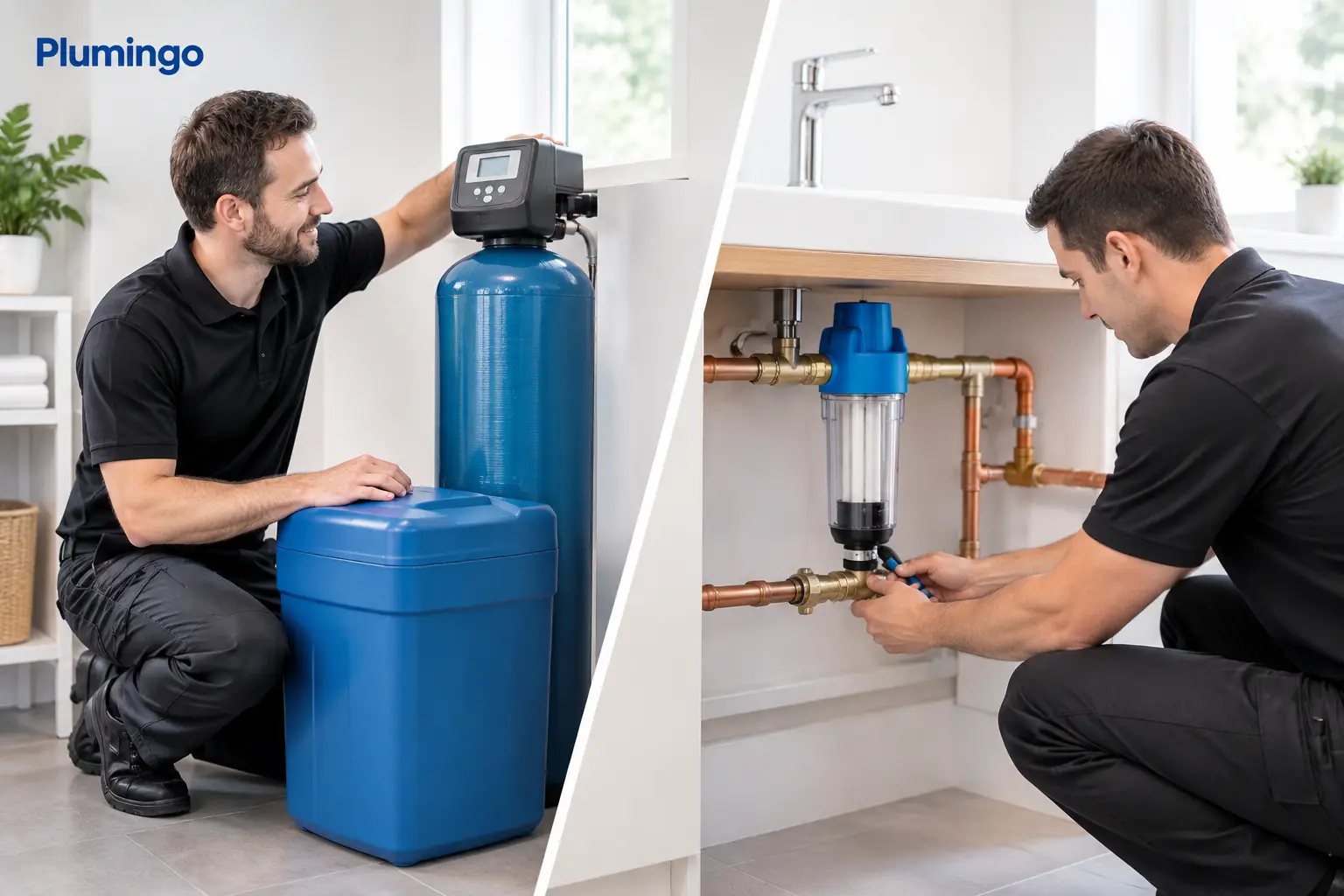
A water softener vs descaler system decision comes down to one question: do you need to remove hardness minerals from your water, or mainly reduce the scale those minerals leave behind? Both systems can support plumbing performance, but they work in fundamentally different ways. Choosing based on price alone can leave you with a system that does not address the issue you actually have.
For homeowners, the signs may be white residue on faucets, stiff laundry, cloudy glassware, or frequent mineral buildup in appliances. For commercial properties, scale can affect water heaters, dishwashing equipment, boilers, and other fixtures that rely on consistent water flow and heat transfer. A proper water test and a clear understanding of the building's needs make the choice much easier.
Water Softener vs Descaler System: The Core Difference
A traditional water softener removes the calcium and magnesium ions that make water hard. Most residential softeners use ion exchange. Water passes through resin beads, which capture hardness minerals and exchange them for sodium or potassium ions. The result is softened water with a lower measurable hardness level.
A descaler generally does not remove calcium and magnesium from the water. Instead, it changes how those minerals behave so they are less likely to form hard deposits on pipes, fixtures, and heating elements. The term can describe several technologies, including template-assisted crystallization systems and electronic or magnetic devices. Their performance, maintenance requirements, and evidence base can vary considerably by technology and water conditions.
That distinction matters. If a laboratory test shows hard water at the tap after a descaler is installed, that does not necessarily mean the unit has failed. It means the system was not designed to remove the minerals in the first place. Conversely, a softener may be more treatment than a property needs if the main concern is reducing scale in a specific piece of equipment.
What a Water Softener Does Well
Water softeners are a proven option when the goal is broad, whole-building hardness reduction. Because they remove the minerals responsible for common hard-water effects, they can improve how water feels during washing and help reduce mineral residue throughout the property.
Softened water can make soap and detergent work more effectively, which may reduce spotting on dishes and buildup around faucets. It can also help protect water-using equipment from scale accumulation. This is especially relevant for tank-style water heaters, tankless units, commercial dishwashers, and other systems where mineral deposits can reduce heating efficiency or restrict flow over time.
There are trade-offs. Most ion-exchange softeners need salt, periodic regeneration, and a suitable drain connection for discharge. The system must be correctly sized for the property's water hardness, household or facility demand, and peak flow needs. An undersized softener may regenerate too frequently or fail to provide consistent soft water during high-use periods.
Softened water also contains added sodium when standard salt is used for regeneration. The amount varies with original water hardness and water use. For people managing sodium intake, or for applications where sodium is a concern, potassium chloride may be an alternative, though it is typically more expensive. A separate drinking-water solution, such as a point-of-use reverse osmosis system, may also be appropriate depending on water quality goals.
What a Descaler Does Well
Descalers are often chosen when scale control is the priority and the owner does not want salt storage, regeneration cycles, or wastewater associated with conventional softening. Some non-salt systems use media designed to encourage minerals to form microscopic crystals that are less likely to adhere to surfaces. These systems can be useful for protecting plumbing and equipment in the right application.
A descaler may be a practical fit for a condominium, a smaller commercial installation, or a property where adding a drain line is difficult. It can also be considered where local rules, site constraints, or maintenance preferences make a salt-based system less desirable.
However, the water will still be hard in the conventional sense. It may not feel as silky for bathing, laundry may not see the same detergent benefits, and existing mineral deposits will not disappear overnight. Descaling systems are primarily preventive. They aim to limit new scale formation rather than deliver the full range of changes associated with softened water.
Electronic and magnetic descalers require particularly careful evaluation. Results can depend on water chemistry, pipe material, flow pattern, and installation quality. They should not be treated as interchangeable with a properly engineered salt-free conditioning system or an ion-exchange softener. Ask what technology is being proposed, what it is designed to address, and how its performance will be assessed.
Compare the Ownership Requirements
The better system is not always the one with the lowest initial equipment cost. Ownership involves installation requirements, routine care, operating costs, and the consequences of choosing the wrong approach.
A water softener requires ongoing salt or potassium replenishment. Its resin tank and control valve also need periodic inspection, particularly where water contains iron, sediment, chlorine, or other contaminants that can affect resin performance. In some cases, pretreatment is needed before a softener to protect the equipment and achieve reliable results.
A salt-free descaler generally has simpler routine upkeep. Depending on the model, its media may need replacement after a defined service life. It still needs professional sizing and installation. Poor flow rates, untreated sediment, or water chemistry outside the system's operating range can limit its effectiveness.
For a commercial operator, maintenance planning should include more than the treatment unit itself. Water heaters, boilers, ice machines, dishwashers, and filtration equipment all have different water-quality tolerances. A system that is suitable for restroom fixtures may not be sufficient for a high-temperature food-service appliance. Reviewing the full plumbing and equipment setup prevents treatment decisions from being made in isolation.
Which System Fits Your Property?
Choose a water softener when you want measurable hardness reduction across the property. It is often the stronger option for households frustrated by soap scum, dry-feeling skin or hair, dull laundry, mineral spots, and recurring scale in appliances. It is also a solid choice for facilities where water hardness threatens equipment efficiency and maintenance costs.
Consider a descaler when reducing scale risk is the primary goal, water softness is not essential, and avoiding salt and regeneration is a priority. It may be well suited to certain plumbing protection applications, particularly when the incoming water chemistry falls within the manufacturer's recommended range.
Neither option replaces a complete water assessment. Hardness is only one part of water quality. Iron can stain fixtures and foul softener resin. Sediment can clog valves and filters. Low pH can contribute to corrosion, while high total dissolved solids may call for a different solution at the drinking-water tap. Well water and municipal water can present different treatment needs, and conditions can vary even between nearby properties.
Start With Testing, Not Assumptions
Before selecting equipment, test the incoming water and review the property's actual symptoms. At a minimum, evaluate hardness, iron, manganese, pH, total dissolved solids, and sediment where relevant. For commercial sites, also document the equipment being protected, daily demand, operating temperatures, and any manufacturer requirements.
A qualified water treatment professional can translate those results into an appropriately sized recommendation. That may be a softener, a descaler, prefiltration, reverse osmosis at selected taps, or a combination of systems. The goal is not to install the most equipment. It is to install treatment that addresses the water and protects the plumbing system without adding unnecessary maintenance.
The most useful next step is simple: identify whether you are trying to change the water itself or prevent mineral deposits from affecting your plumbing and equipment. Once that answer is clear, the right system becomes a practical service decision rather than a guessing game.
Need this done in your home?
Plumingo handles this work across Kitchener, Waterloo, Cambridge and Guelph. Read how we do it, or call us and we will give you a price before we start.
Learn about water softener sales and serviceNeed a plumber in Kitchener-Waterloo?
Licensed, insured and upfront about pricing. Call us or book online in under a minute.