
A five-star rating can tell you that a filter arrived on time. It cannot tell you whether it addresses the contaminants in your water, fits your plumbing, or will still perform well after six months of daily use. Useful water filter reviews look beyond convenience and appearance. They focus on what the system removes, what it costs to maintain, and whether it suits the building it serves.
For homeowners, property managers, and business operators, the right choice is rarely the most expensive system or the one with the boldest claims. It is the system that matches the water source, usage level, available space, and maintenance capacity.
How to Read Water Filter Reviews With Confidence
Start by separating product feedback from water-quality evidence. A review saying that water tastes better is helpful, but taste alone does not confirm the reduction of a specific contaminant. Look for a clear statement of what the filter is designed to reduce and the standard or certification supporting that claim.
Filter performance is specific. One model may be designed for chlorine taste and odor, while another targets lead, cysts, sediment, or certain dissolved solids. Reverse osmosis systems can address a broader range of dissolved contaminants, but they require more space, periodic service, and a suitable installation. A water softener handles hardness minerals such as calcium and magnesium, which is a different job from drinking-water filtration.
The strongest reviews explain the water issue first, then assess the equipment. If a reviewer never identifies the water source or concern, their recommendation may not apply to your home or facility.
Check the contaminant claim, not the category name
Terms such as “water purifier,” “advanced filtration,” and “clean water system” are broad marketing language. The meaningful details are the specific contaminants listed in the product documentation and the conditions under which the system was tested.
For example, carbon filtration is often an effective choice for improving chlorine taste and odor in municipally supplied water. It may not be the right stand-alone solution for every dissolved contaminant. Sediment filters protect fixtures and downstream equipment from particles, but they do not make the same claims as carbon or reverse osmosis membranes.
When comparing systems, ask three direct questions: What does it reduce? At what capacity? What must be replaced or serviced to maintain that performance? Reviews that answer all three are more valuable than reviews focused only on initial water taste.
Understand certifications and testing language
Independent certification can add confidence, particularly when a filter is making a contaminant-reduction claim. Read the claim carefully. Certification generally applies to a defined model, cartridge, contaminant, and set of operating conditions. It is not a blanket guarantee that every water concern has been solved.
A credible review may reference certification, but it should also acknowledge limitations. Water pressure, incoming water quality, filter age, and correct installation all affect results. A system that works well in one home may need a different configuration in another.
For a commercial site, documentation matters even more. Facility managers should retain system specifications, maintenance records, and cartridge change schedules. That creates a clear service history and helps prevent performance from being judged only after a complaint arises.
Match the Filter to the Water Problem
The best filtration decision starts with an accurate picture of the water, not a product shortlist. Municipal water, private well water, and building plumbing can create different concerns. Even two properties on the same supply can have different taste, hardness, pressure, or fixture-scale issues.
A basic water test is often worthwhile when there is a persistent concern, a change in taste or appearance, recurring scale, or a need to select a higher-capacity treatment system. Testing helps avoid paying for treatment that does not address the actual issue.
When a point-of-use filter makes sense
Point-of-use systems treat water at a specific location, usually a kitchen sink. They are practical when the goal is better drinking and cooking water without changing the supply to the entire building.
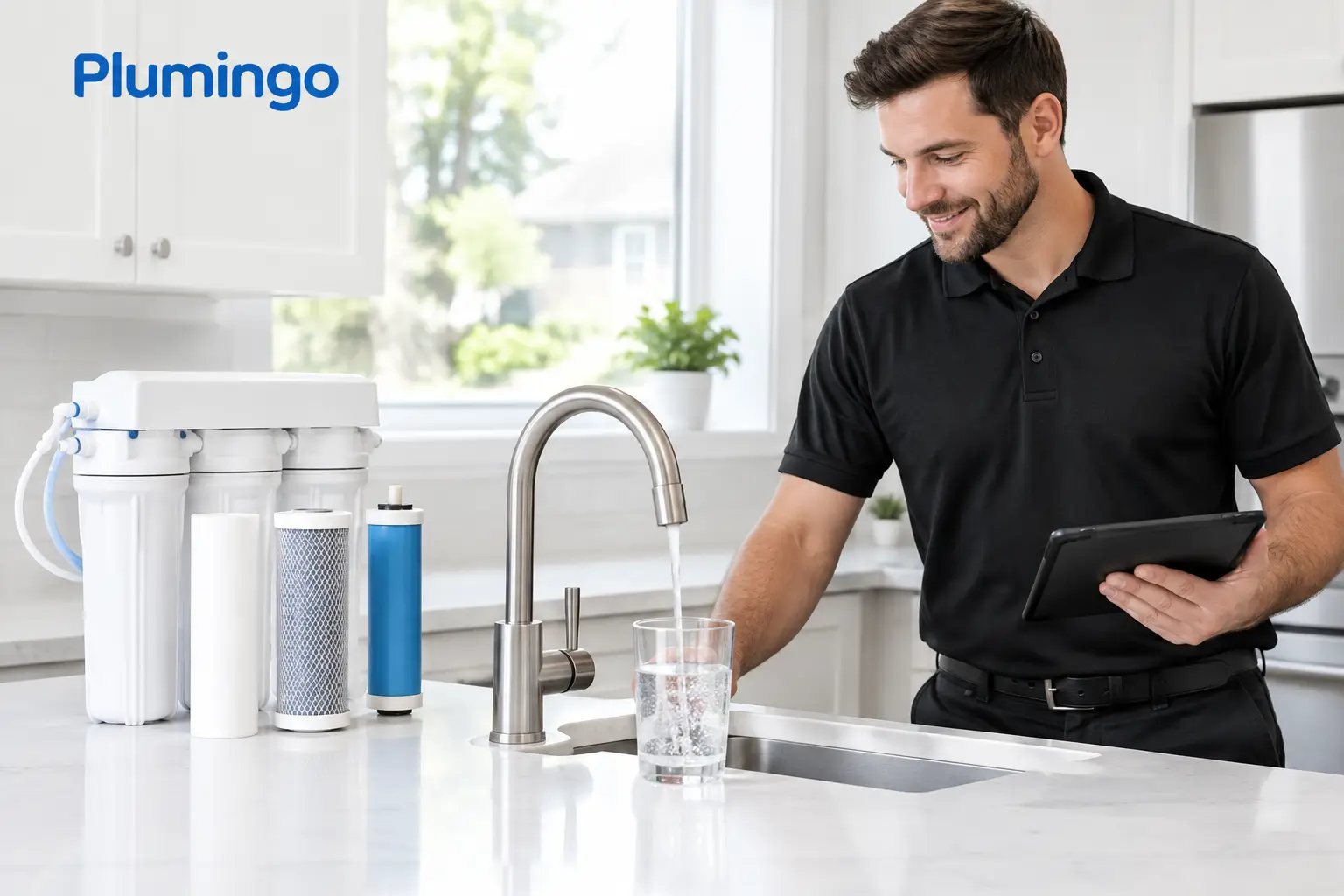
Countertop pitchers and faucet-mounted filters can be convenient for light use, but their capacity is limited and replacement timing is easy to overlook. Under-sink filters offer a more permanent setup and can support higher daily use. An under-sink reverse osmosis system can be appropriate for households that want targeted drinking-water treatment, provided there is room for the tank, drain connection, and service access.
Reviews should mention flow rate. A filter that produces excellent water but fills a glass slowly may frustrate a busy household. With reverse osmosis, consider the storage capacity and recovery time as well as the quality of the filtered water.
When whole-home treatment is the better fit
Whole-home systems are installed where water enters the property. They are useful when the concern affects showers, laundry, fixtures, appliances, or multiple taps. Sediment filtration, carbon treatment, and water softening are common examples, though each serves a distinct purpose.
Hard water is a good illustration. A drinking-water filter may improve the water at one sink, but it will not stop mineral scale from building on faucets, water heaters, dishwashers, or shower doors. A properly sized water softener can address hardness throughout the property. It also needs regular salt replenishment, appropriate drain access, and periodic inspection.
For multi-unit buildings and commercial properties, sizing is critical. A system built for a small household may restrict flow or exhaust its media too quickly in a café, office, or rental building. Reviews that do not state household size, usage, or demand level should be treated as a starting point rather than a final recommendation.
Look Beyond the Purchase Price
A low upfront price can become expensive if cartridges are costly, hard to source, or needed more frequently than expected. Conversely, a higher-quality installed system may offer more predictable maintenance and better long-term fit. The right comparison includes the full operating picture.
Consider filter replacement intervals, annual cartridge cost, service access, water use, and installation requirements. Reverse osmosis systems may produce wastewater as part of the filtration process. Water softeners use salt and regeneration water. These are normal trade-offs, not automatic reasons to avoid either solution, but they should be understood before purchase.
Reviews are especially useful when they report ownership over time. Look for feedback from customers who have changed cartridges, cleaned a system, scheduled service, or dealt with a pressure change. Initial impressions matter, but long-term maintenance is where many filter decisions prove themselves.
Installation Quality Affects Every Review
Even a well-reviewed filter can underperform when installed incorrectly. Common issues include poor drain connections, inadequate pressure, inaccessible filter housings, leaks at fittings, and systems placed where homeowners cannot easily complete routine maintenance.
Professional assessment is valuable when selecting under-sink reverse osmosis equipment, a whole-home filter, or a water softener. It confirms that the system is sized for the property and that installation does not create avoidable plumbing complications. For businesses, professional setup also helps coordinate treatment equipment with existing plumbing and service schedules.
At Plumingo, filtration and water-treatment service is approached as part of the property’s overall plumbing performance. That means checking how the system will be maintained, not simply whether it can be installed today.
Questions a Good Review Should Answer
Before relying on a review, see whether it provides enough context to be useful. The most helpful reviews usually identify the water source, the system type, the reason it was chosen, and how long it has been in service. They may also mention installation complexity, filter-change costs, pressure or flow, and whether the owner noticed a difference in taste, scale, or appliance performance.
Be cautious with reviews that promise a filter fixes every water issue. No single system is ideal for every property. A practical recommendation recognizes boundaries: a carbon filter may be enough for one home, while another needs softening, reverse osmosis, or a combination of treatment methods.
Make the Decision Easier
Treat water filter reviews as evidence to investigate, not a substitute for understanding your water and plumbing. Narrow the options by the issue you want to address, compare verified performance claims and maintenance needs, then confirm that the system fits your space and usage.
The best filter is the one you can maintain consistently, that addresses a clearly defined concern, and that works quietly with the rest of your plumbing for years to come.
Need this done in your home?
Plumingo handles this work across Kitchener, Waterloo, Cambridge and Guelph. Read how we do it, or call us and we will give you a price before we start.
Learn about reverse osmosis and water filtrationNeed a plumber in Kitchener-Waterloo?
Licensed, insured and upfront about pricing. Call us or book online in under a minute.