
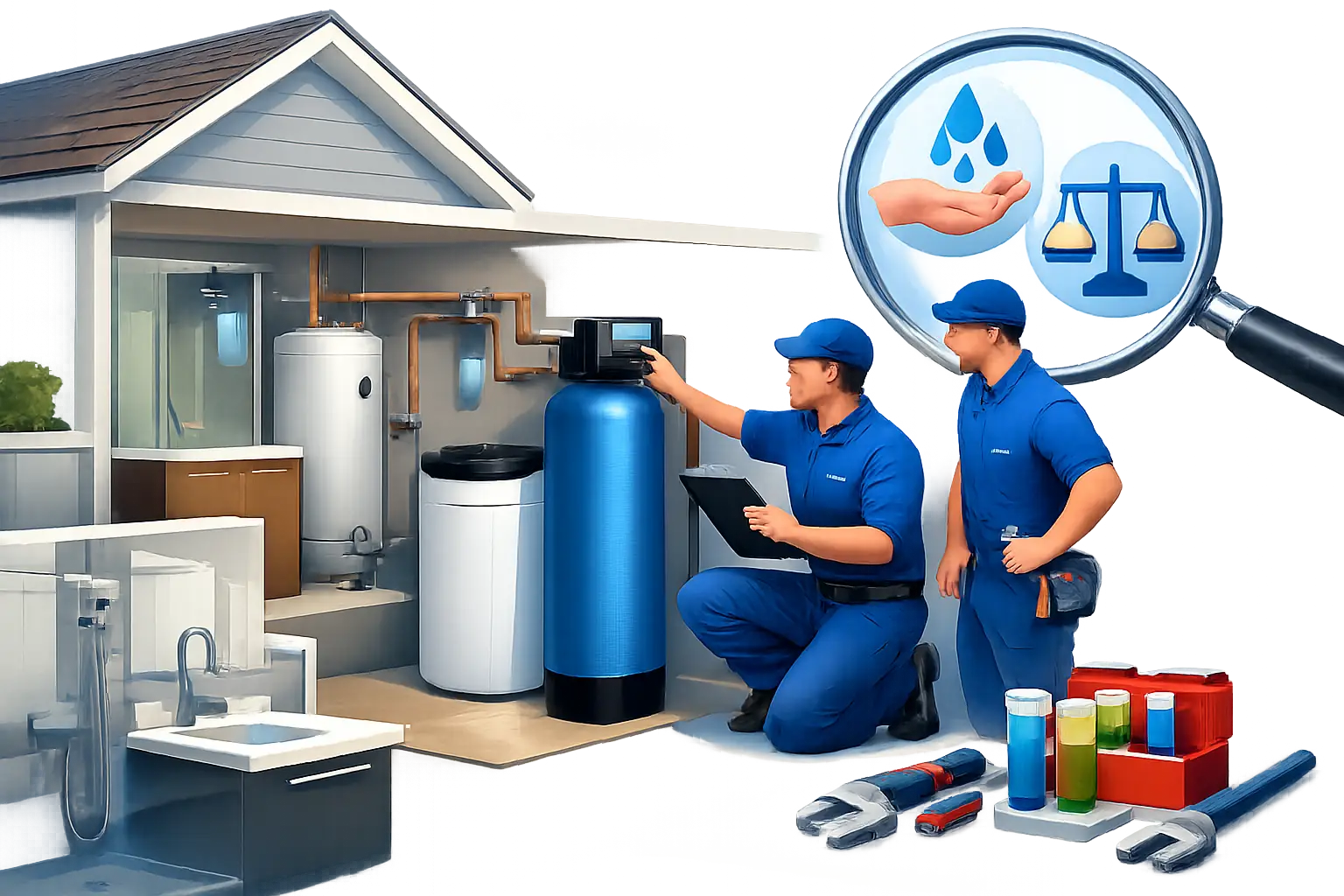
A water softener should solve a measurable problem, not simply add another appliance to the mechanical room. A useful water softener system review looks beyond a product's advertised grain count and asks whether it matches the building's water hardness, daily demand, plumbing layout, and maintenance expectations. That is how homeowners, property managers, and commercial operators can choose a system that performs consistently.
Hard water commonly leaves white mineral scale on fixtures, shortens the effective life of water-using equipment, and makes soap harder to rinse. A correctly selected softener can reduce those effects. The best choice, however, is not always the largest tank or the lowest upfront price.
Start With the Water, Not the Equipment
System selection begins with a water test. Hardness is usually measured in grains per gallon or parts per million, and the result determines how much resin capacity the softener needs. If iron is present, it also changes the calculation because iron uses up softening capacity and may require pre-treatment.
For a home on municipal water, a current hardness test and a review of local water conditions provide a solid starting point. Private well water calls for a broader analysis. Iron, manganese, sulfur odor, sediment, pH, and bacteria are separate concerns. A standard softener may help with some dissolved iron, but it is not a complete answer for every well-water issue.
Commercial properties need an even clearer picture of demand. A small office, a multi-unit building, a restaurant, and a light industrial facility can all have very different peak-use patterns. Reviewing average use alone may lead to undersizing when several fixtures or appliances operate at the same time.
Water Softener System Review: The Features That Matter
Once the water conditions are clear, compare systems by the components that affect real-world service. Capacity, valve quality, resin, and installation design matter more than cosmetic features.
Capacity should fit household or facility demand
A softener's grain capacity describes how much hardness it can remove before regeneration. Bigger is not automatically better. An oversized system can use more salt and water than necessary if it is programmed poorly, while an undersized system may regenerate too often and allow hard water through during high-demand periods.
A practical sizing review considers hardness level, number of occupants or users, estimated daily water consumption, iron content, and the desired regeneration schedule. For many residences, a metered system that regenerates according to actual water use is more efficient than a timer-based unit that follows a fixed schedule.
For commercial settings, flow rate deserves equal attention. A system may have sufficient total capacity but still restrict water flow if the control valve, media tank, or plumbing connections are too small. This can show up as reduced pressure during busy periods.
The control valve is the working center of the system
The control valve directs water through service, backwash, brine draw, rinse, and regeneration cycles. It is one of the most consequential parts of a water softener. A quality valve should be serviceable, correctly programmed, and accessible for maintenance.
Digital metered valves offer useful settings, but only when those settings are matched to the site. The installer should set hardness, reserve capacity, regeneration time, and salt dose based on actual conditions rather than relying on a generic default. Clear access to the valve also makes future inspection and repair more straightforward.
Resin quality affects long-term performance
Resin is the media that exchanges hardness minerals for sodium or potassium ions. Its condition directly affects softening results. Quality resin, proper tank sizing, and appropriate regeneration settings support longer service life.
Chlorinated municipal water can gradually wear down standard resin. In some cases, chlorine-resistant resin or carbon pre-filtration may be worth considering. This depends on local water chemistry and expected usage, not just the age of the property.
Salt-based softeners and salt-free conditioners are not interchangeable
A conventional ion-exchange softener removes calcium and magnesium from the water. It is the most direct option when the goal is softer water, less scale, and improved soap performance.
Salt-free conditioners are designed to alter how minerals behave rather than remove hardness minerals. They can be appropriate where a property wants scale management without a brine tank, but they do not provide the same results as a true softener. If soft water is the stated goal, confirm that the system uses ion exchange and has the capacity to support the property.
Review the Installation Plan Before Approving Work
A water softener can perform only as well as its installation allows. The unit should be placed where it can treat the intended water supply while leaving appropriate access for salt loading, servicing, and inspection. In most homes, that means installing it after the main water entry point and before the hot water heater, while preserving an untreated line for exterior use when appropriate.
The plumbing plan should include a bypass valve. A bypass allows water service to continue when the system is being serviced or if a repair is needed. Drain routing also deserves attention because regeneration water must discharge through an approved connection with the proper air gap where required.
Before installation, ask the service provider to confirm these four details:
- The tested hardness level and any iron or sediment concerns
- The recommended capacity, flow rate, and regeneration settings
- The location of the bypass, drain connection, and electrical supply
- The expected salt use, maintenance schedule, and service options
This is not paperwork for its own sake. It gives the property owner a clear record of what was selected and why.
Operating Cost Is More Than the Purchase Price
A lower-priced system can cost more over time if it regenerates frequently, wastes salt, or requires difficult-to-source parts. Conversely, a premium unit is not automatically the best value if its capacity far exceeds the building's needs.
Salt usage, water used during regeneration, replacement parts, resin life, and professional maintenance all belong in the comparison. Metered regeneration generally helps control operating costs because the system responds to actual consumption. High-efficiency settings can also reduce salt use, although settings should never be pushed so far that softening performance suffers.
Potassium chloride is an alternative regenerant for some systems, but it generally costs more than sodium chloride and may require adjusted settings. For homes managing sodium intake, it is worth discussing with a qualified water treatment professional and, when needed, a health professional. Most households use relatively little drinking water from the softened line, and a separate reverse osmosis drinking-water system can be considered for the kitchen.
Maintenance Signals Worth Paying Attention To
Water softeners are dependable when they receive basic care. Keep the brine tank supplied with the recommended salt, prevent salt bridging, and avoid letting debris accumulate at the bottom of the tank. Salt bridges occur when a hardened crust forms above the water, leaving the system unable to make brine even though the tank appears full.
Changes in water feel or fixture scale can indicate that the unit needs attention. Other signs include unusually high salt use, constant cycling, water in the brine tank when it should be low, or a display showing valve errors. These symptoms do not always mean replacement is necessary. A blocked injector, worn seal, incorrect programming, or brine-line issue may be repairable.
For property managers, scheduled inspections can prevent small maintenance issues from becoming disruptive. Keeping records of salt deliveries, settings, service visits, and any changes in water quality also helps identify patterns across multiple units or buildings.
Questions to Ask During a Water Softener System Review
A credible recommendation should be easy to explain. Ask what water test results support the proposed system, how capacity was calculated, and what the expected regeneration frequency will be. Ask whether the quoted work includes installation materials, bypass plumbing, drain connection, startup programming, and disposal or removal of an existing unit if applicable.
It is also reasonable to ask which parts are designed to be serviced and what routine maintenance the owner will handle. Transparent answers help distinguish a system designed for long-term care from one selected only for a quick installation.
Plumingo approaches water treatment as part of the property's broader plumbing performance. That means reviewing the existing water supply, drain access, and equipment needs before recommending a softener service or repair path.
A well-chosen water softener should be quiet in the background: fewer scale deposits, more predictable appliance care, and settings that match how the property actually uses water. Start with a water test, insist on a clear sizing explanation, and keep the system accessible enough to be maintained properly.