
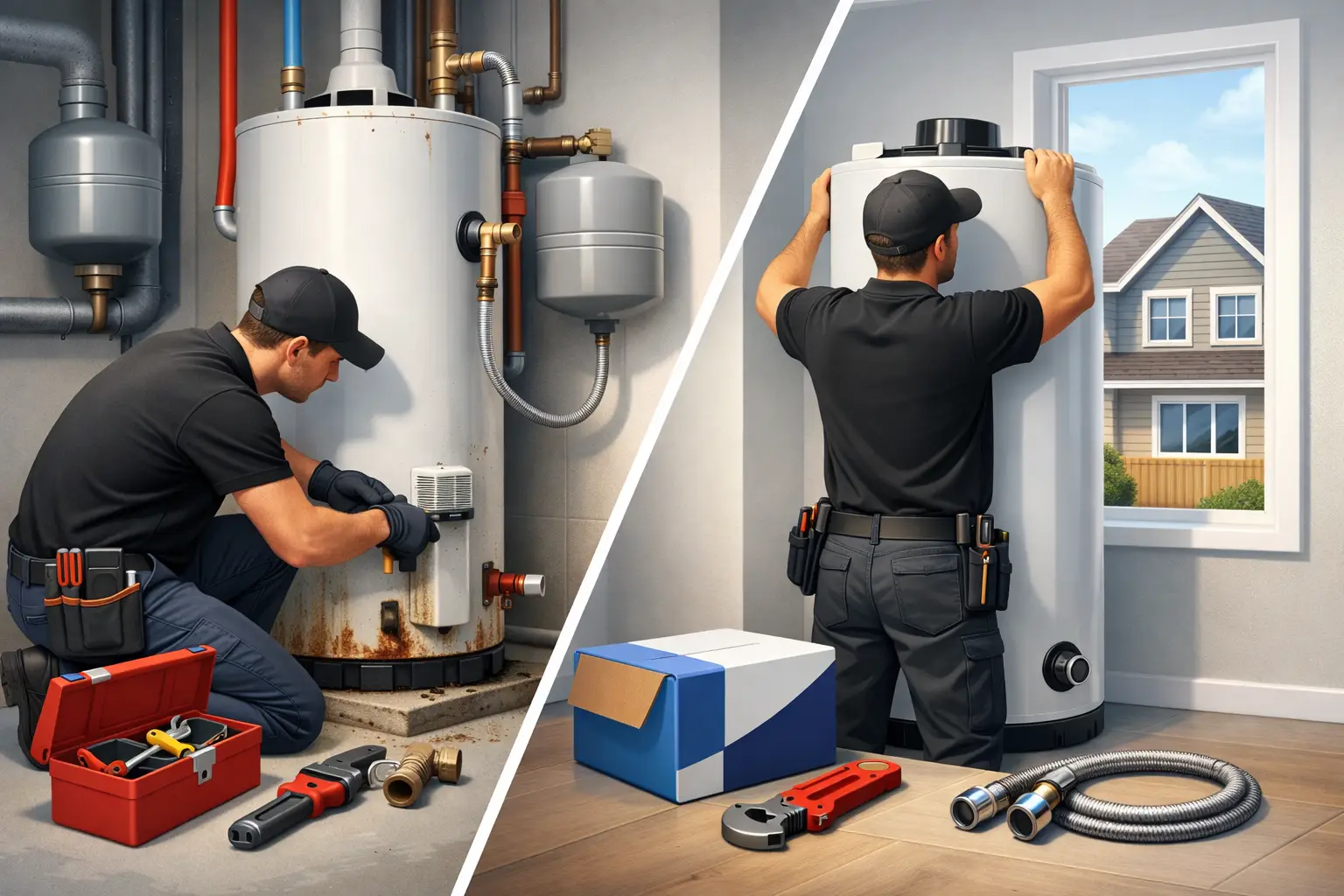
A water heater rarely chooses a convenient time to act up. The shower turns lukewarm, a utility-room floor feels damp, or a business suddenly has limited hot water for staff and customers. Water heater repair versus replacement is not a decision that should be based on one symptom alone. The right answer depends on the unit’s age, the source of the problem, the condition of the tank, expected operating costs, and how critical reliable hot water is to the property.
A professional assessment can separate a repairable component issue from a tank that has reached the end of its useful service life. That clarity matters because a well-timed repair can protect your budget, while replacing a failing unit before it causes water damage can protect the building.
Start With the Type and Age of the Water Heater
Conventional tank water heaters commonly provide reliable service for roughly 8 to 12 years, although maintenance, water conditions, usage patterns, and installation quality can move that range in either direction. Tankless water heaters often have a longer service life, but they still require periodic maintenance and can develop issues with valves, sensors, ignition components, or mineral buildup.
Age alone does not automatically mean replacement. A seven-year-old tank with a worn heating element may be an excellent repair candidate. A ten-year-old tank with corrosion at the bottom seam is a different situation. The key question is whether the repair addresses a contained problem or merely buys a little time on a deteriorating system.
Check the manufacturer label for the serial number and installation date, if available. If you are unsure of the unit’s age, a qualified technician can help identify it and evaluate its overall condition.
When Water Heater Repair Makes Sense
Repair is often the practical choice when the tank itself is sound and the issue is limited to a serviceable part. Many common hot-water problems have straightforward causes that do not require replacing the full system.
No Hot Water or Inconsistent Temperature
For electric units, failed heating elements, thermostats, wiring connections, or reset switches can cause poor hot-water performance. For gas units, the issue may involve the pilot assembly, igniter, thermocouple, gas control valve, or venting-related safety components. These repairs vary in complexity, but a component failure does not necessarily mean the tank has failed.
Before assuming the heater is the problem, consider demand. A growing household, a newly added bathroom, or a commercial change in occupancy can make a formerly adequate unit feel undersized. In that case, the system may be working properly but no longer matches the property’s hot-water needs.
Leaks From Fittings or Valves
Not every leak means a new water heater. Water around the unit may come from a loose connection, temperature and pressure relief valve, drain valve, supply line, or nearby plumbing. These issues should be diagnosed promptly, but many can be repaired without replacing the heater.
The location of the leak is what matters most. A leak from the tank body, especially near the bottom or along a seam, usually points to internal corrosion. That is generally not repairable.
Sediment and Maintenance Issues
Mineral sediment can collect at the base of a tank, reducing heating efficiency and sometimes causing popping or rumbling sounds. In areas with hard water, buildup can develop more quickly. Flushing a tank, inspecting the anode rod, and addressing water hardness can extend performance when done before corrosion becomes severe.
Tankless systems can also develop scale in their heat exchangers. Professional descaling may restore output and help protect efficiency. If your property uses a water softener or filtration system, keeping that equipment properly maintained supports the entire plumbing system, including the water heater.
When Replacement Is the Better Investment
Replacement becomes the more responsible choice when a repair cannot restore dependable operation, when failure risk is increasing, or when a new system would materially improve capacity or efficiency.
The Tank Is Corroded or Leaking
Rust-colored water, visible corrosion near the tank base, or water escaping from the tank itself are serious indicators. Internal tank linings cannot be restored once they have deteriorated. Continuing to operate a leaking tank can lead to a larger leak and avoidable damage to flooring, walls, stored items, or commercial equipment nearby.
A technician can confirm whether moisture is coming from the tank or an external connection. That distinction prevents unnecessary replacement while ensuring a failed tank is not overlooked.
Repair Costs Are Rising
A single modest repair on a newer unit can be sensible. Repeated service calls, multiple aging components, or an expensive repair on an older heater deserve a more careful cost comparison. There is no universal percentage that automatically determines the answer, because labor, unit type, replacement options, and the property’s needs all matter.
Still, if the heater is near the end of its expected life and the repair is substantial, replacement may offer better long-term value. A new unit typically includes warranty protection and can reduce the uncertainty that comes with an aging system.
Your Hot-Water Needs Have Changed
Replacement is also an opportunity to correct sizing. A home with additional residents, larger soaking tubs, or back-to-back shower demand may need a larger tank or a different recovery rate. Restaurants, salons, multi-unit properties, and other commercial settings should evaluate peak demand rather than simply replacing the old unit with the same capacity.
An undersized water heater wastes time and creates daily frustration. An oversized model can add unnecessary upfront cost and standby energy use. Proper sizing should account for fixture count, usage timing, fuel source, available space, venting, electrical capacity, and local installation requirements.
Comparing Operating Costs, Not Just Purchase Price
The least expensive option today is not always the least expensive choice over the next several years. Older tank heaters can lose efficiency as sediment accumulates and components wear. Modern high-efficiency tank models and tankless systems may reduce energy use, but their value depends on household demand, fuel prices, installation requirements, and maintenance habits.
Tankless water heaters are not automatically the right upgrade for every property. They provide hot water on demand and can save space, but they may require changes to gas supply, venting, electrical service, or water treatment. A conventional tank replacement may be the more economical and dependable fit when installation conditions or usage patterns do not support a tankless conversion.
For commercial properties, downtime and capacity can carry more weight than energy savings alone. A system that supports operations reliably may be worth more than a lower-cost unit that struggles during peak use.
A Practical Water Heater Repair Versus Replacement Checklist
Before authorizing work, ask for a clear explanation of the failure, the expected repair scope, and the condition of the tank or heat exchanger. You should also understand whether the proposed repair is expected to resolve the issue or simply extend service temporarily.
A useful decision considers four factors together: the unit’s age, whether the tank is intact, the cost and durability of the repair, and whether the current system still meets demand. Photos, test results, and a written estimate make it easier for homeowners, property managers, and facility operators to compare options with confidence.
It is also wise to ask about maintenance that can protect the next unit. Annual inspection, pressure relief valve checks, flushing where appropriate, anode rod monitoring, and water-quality treatment can all influence service life. The right maintenance schedule depends on the equipment and the property’s water conditions.
Protect the System Before the Next Failure
A water heater does not need to be replaced simply because it has a problem. Equally, a visibly corroded tank should not be kept in service through repeated short-term fixes. The best choice is the one supported by a complete diagnosis, transparent repair and replacement options, and a plan that fits the property’s real hot-water needs.
If performance has changed, address it before a small inconvenience becomes a disruptive outage. A timely inspection gives you room to make a measured decision rather than one made under pressure.