
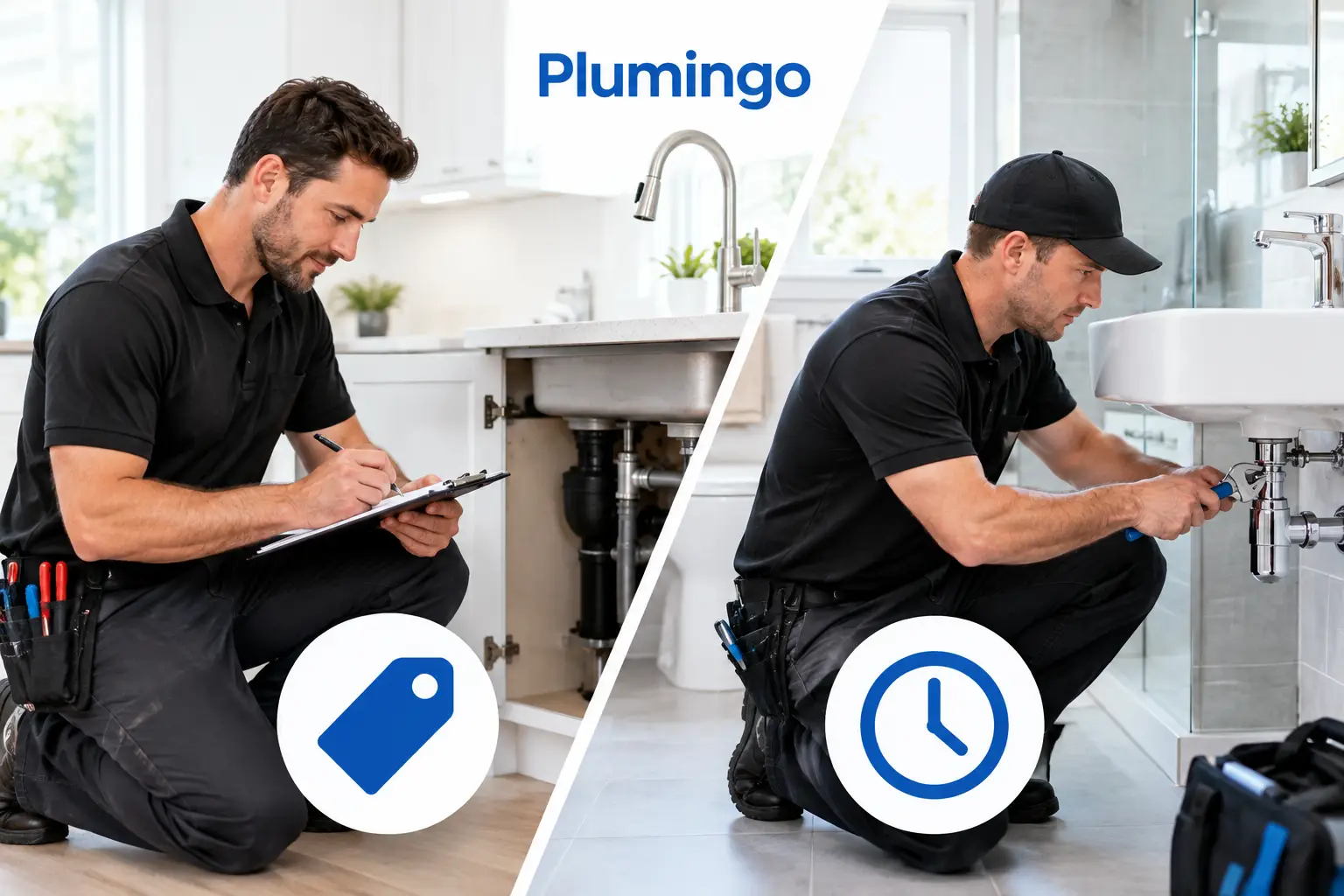
A leaking shutoff valve, a slow drain, or a water heater concern usually raises the same practical question before any work begins: what will this cost? In the flat rate plumbing versus hourly pricing decision, neither model is automatically better. The right choice depends on how clearly the problem can be identified, how much investigation it needs, and what is included in the quoted scope.
For homeowners, property managers, and business operators, pricing clarity matters as much as technical skill. A professional plumbing visit should make the recommended work, the expected cost, and the next steps easy to understand before repairs move forward.
What Flat Rate Plumbing Means
Flat rate plumbing assigns a set price to a defined service or repair. Rather than billing for every minute on site, the provider quotes a price for completing a specific task, such as replacing a faucet cartridge, installing a toilet fill valve, clearing a straightforward drain blockage, or servicing a water softener.
The price typically reflects more than labor time. It may account for the technician's expertise, standard materials, equipment, travel, administrative costs, and the responsibility to complete the stated repair. The customer knows the approved price before work starts, provided the scope does not change once the repair is underway.
This approach works best when the issue is visible or can be diagnosed quickly. If a technician can confirm that a failed pressure-reducing valve is causing the problem, a flat-rate repair can provide a clear decision point: approve the work at the stated price or consider alternatives.
Flat rates also make it easier for property managers to plan small repairs across multiple units. A consistent price for a common repair can simplify approvals, tenant communication, and maintenance records.
Where Flat Rates Need Careful Scoping
A flat rate is only as useful as the scope behind it. “Fix the leak” may sound simple, but a leak beneath a kitchen sink could come from a loose connection, a cracked drain assembly, a failed shutoff valve, or damaged piping inside a cabinet wall. Those are different repairs with different material and labor requirements.
A trustworthy estimate should state what is included and identify assumptions. For example, a quoted fixture replacement may cover installation of a standard customer-supplied faucet but not cabinet modifications, corroded shutoff replacement, or concealed pipe repairs discovered after removal. Clear exclusions are not a hidden charge. They help prevent misunderstandings if the job reveals conditions that were not visible at the start.
How Hourly Plumbing Pricing Works
Hourly pricing separates the service call, labor time, and materials. The final bill is based on the time required to diagnose and complete the work, plus any parts or specialty equipment used. Some providers use minimum labor charges or different rates for scheduled and priority service windows.
This model is often appropriate when the work is difficult to define in advance. A persistent drain backup, intermittent water pressure issue, hidden leak, or commercial plumbing concern may require testing and investigation before anyone can responsibly promise a fixed repair price.
Hourly billing can also fit maintenance and troubleshooting tasks where the goal is to assess a system, not replace a known component. For example, investigating inconsistent reverse osmosis water flow may involve checking filter age, tank pressure, tubing restrictions, shutoff valves, and membrane performance. The needed repair may not be apparent at the door.
For larger projects, hourly labor may be paired with a detailed estimate for materials and milestones. This is common when access conditions, building requirements, or discovered damage can affect the amount of work required.
What to Ask About an Hourly Rate
The hourly rate alone does not tell the full story. Ask whether diagnostic time is billed, whether there is a minimum charge, how materials are priced, and whether time spent collecting parts is included. It is also reasonable to ask for a range once the technician has assessed the issue.
Good communication matters here. A technician should explain when the work has moved beyond the original diagnosis and seek approval before proceeding with a more extensive repair. Hourly pricing should never mean an open-ended commitment without updates.
Flat Rate Plumbing Versus Hourly: The Practical Trade-Off
The key trade-off is predictability versus flexibility. Flat rate pricing provides stronger cost certainty for a defined repair. Hourly pricing provides flexibility when the problem is uncertain, access is limited, or the work may change based on what is found.
Consider a toilet that runs continuously. If the technician confirms the fill valve has failed and no other issue is present, flat-rate pricing is usually easy to understand. If the toilet is leaking at the base and the flooring around it is soft, the repair may require removing the fixture, assessing the flange, checking the subfloor, and determining what can be repaired safely. That second situation may begin as a diagnostic visit and move to a revised estimate once the conditions are known.
Neither outcome signals poor service. Plumbing systems often hide important details behind walls, beneath floors, or inside equipment. The standard to look for is not a guaranteed price before diagnosis. It is a clear explanation of the pricing method and approval before additional work is performed.
When Flat Rate Pricing Is Often a Good Fit
Flat rate pricing is commonly useful for routine, well-defined work. Examples include replacing a visible fixture component, installing a standard disposal, changing accessible shutoff valves, servicing a known water softener issue, or completing a specified filtration service.
It can be especially helpful when a homeowner wants to compare repair options without tracking labor time. It may also give commercial operators a cleaner way to authorize recurring repairs, provided the scope is documented clearly.
That said, the lowest flat price is not always the best value. Confirm the quality of the part being installed, whether required testing is included, and whether the repair addresses the cause of the issue rather than only the visible symptom. A premium fixture component or water treatment part may cost more upfront while delivering better performance and service life.
When Hourly Pricing Can Be the Better Choice
Hourly pricing is often the more practical option for diagnostics, complex repairs, and systems with unknown conditions. It can be appropriate when a building has aging plumbing, prior repairs of uncertain quality, limited pipe access, or an issue that occurs only at certain times.
Commercial properties may also need hourly troubleshooting when a problem affects multiple fixtures or zones. Low water pressure in one restroom, for instance, could relate to a localized valve, a fixture restriction, a supply issue, or a larger building condition. Starting with a defined diagnostic process avoids pricing a repair before the cause is established.
For water quality concerns, an assessment can be equally valuable. Changes in taste, spotting, reduced filtration flow, or softener performance do not always mean the equipment needs replacement. Filter service, cleaning, recalibration, or a targeted repair may be the appropriate recommendation.
How to Compare Plumbing Quotes Fairly
Before approving work, compare the scope, not just the final number. Two quotes that appear similar may cover very different levels of service. One may include the part, installation, testing, cleanup, and removal of the failed component, while another may list only labor.
Ask for the diagnosis in plain language, the repair recommendation, and the price structure. If the work is flat rate, ask what conditions could change the quote. If it is hourly, ask for the current rate, minimum charge, estimated time range, and the point at which the technician will request further approval.
For planned replacements or upgrades, ask whether repair remains a reasonable option. Replacing equipment can be appropriate when reliability, efficiency, part availability, or recurring repair costs justify it. But when a repair can restore safe, dependable performance, it deserves to be part of the conversation.
A Better Way to Choose
Choose flat rate plumbing when the repair is clearly defined and price certainty is your priority. Choose hourly billing when the issue needs real investigation or the conditions may change once work begins. In either case, the best experience comes from a provider that documents the scope, explains the options, and obtains approval before moving beyond the agreed work.
For Kitchener homeowners and property teams, Plumingo approaches plumbing and water treatment service with that same focus on clear recommendations and transparent pricing. A well-defined repair should feel straightforward, while a complex problem should be explained before decisions are required. That is the kind of clarity that helps you protect both your property and your budget.